The hidden half
Ductwork Repair and Sealing
Houston attics run well past 130 degrees in summer. Leaky, crushed or disconnected duct dumps the air you paid to cool straight into that heat, and no thermostat setting fixes it from downstairs.
Why the room at the end of the hall is always hotter
Every duct run has to push air against resistance, what techs call static pressure, and a system sized for the house does not account for a return that was undersized when the house was built or a flex run that got crushed under someone's foot in the attic. The room furthest from the air handler is usually the one that loses that fight first. It is not a bad vent or a closed door, most of the time it is a duct that has lost pressure somewhere between the unit and that room, either from a disconnected joint, a hole worn through the insulation jacket, or a run that has been pinched flat where it crosses a joist. The air left the unit cold. It did not arrive that way.
Sealing versus replacing, and what decides it
Most duct problems get fixed by sealing, mastic and proper strapping at the joints, reinsulating a run that has lost its jacket, or replacing a section that has been crushed rather than the whole system. Full replacement gets talked about when the duct is old enough that the insulation has broken down across most of the run, or when a house has been added onto and the original layout was never built for the load it carries now. We open the attic hatch, look at what is actually up there, and tell you which one applies to your house instead of quoting a number before we have seen it.
Air City, Licensed and insured, TACLB00114911E. Call (713) 804-7005.
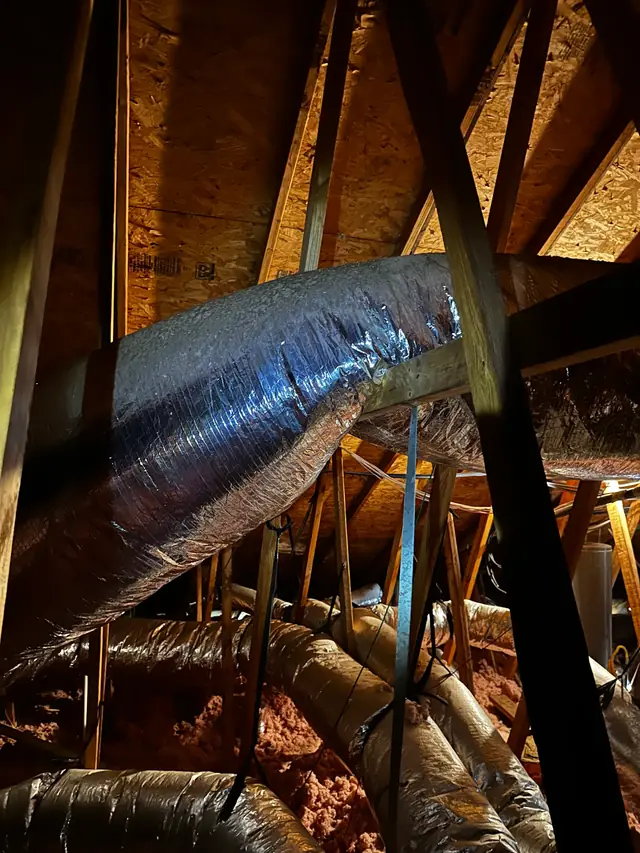
From the attic hatch
What you can actually see without crawling the whole attic
You do not need to crawl the whole attic to get a sense of what is going on. A flashlight from the hatch will usually show a run that is sagging low enough to pool condensation, insulation jacket that is split and exposing bare duct, or a joint that has visibly pulled apart with tape hanging loose. What you cannot see is the static pressure or the air actually getting lost between the unit and the register, which is the part that needs a tech and a gauge rather than a flashlight.
Leaky duct in a 130 degree attic also feeds humidity and dust straight into the system, which is a big part of what our indoor air quality work deals with. A full breakdown of everything we cover is on the main services page.